Category: Uncategorized

  • How to Spec a Custom Handheld Running Water Bottle: Format, Capacity, and Fit

    How to Spec a Custom Handheld Running Water Bottle: Format, Capacity, and Fit

    Most guides to running bottles start with color and logo placement. The decision that actually shapes how a bottle performs on the road happens earlier, when you choose the format and the capacity. A handheld running water bottle lives in one hand for the length of a run, so a 100-milliliter mismatch or a strap that does not cinch down becomes a genuine annoyance by mile three. This walkthrough covers how to specify a handheld the way an experienced buyer would: format first, then capacity, then the strap, and only then the print.

    Soft flask or hard bottle: settle the format first

    Handhelds split into two families, and they behave differently enough that the choice drives everything downstream. A hard bottle holds its shape, refills quickly at an aid station or fountain, and can carry an insulating sleeve to keep water cool. It sloshes as it empties and it still takes up hand space when drained. A soft flask, molded from flexible TPU, collapses as you drink, which kills the sloshing and lets the empty flask fold into a pocket. The trade is that soft flasks are fiddlier to refill on the move and harder to fill with ice or drink powder through a narrow opening.

    There is also a middle option worth knowing about. Hybrid flasks sit between the two: softer than a rigid bottle but more structured than a thin soft flask, usually with a wider valve that pours faster. For a race brand deciding what to hand out, the practical read is simple. Choose a hard handheld when refills are frequent and durability matters, choose a soft flask when weight and pack-down size win, and consider a hybrid when you want one product that does a bit of both.

    Size the bottle to the run, not to the shelf

    Capacity is where buyers most often over- or under-shoot. The common formats cluster into a predictable ladder, from mini soft flasks around 150 milliliters up to large hard handhelds near 590 milliliters, which is roughly 20 ounces. Seeing them side by side makes the gaps obvious.
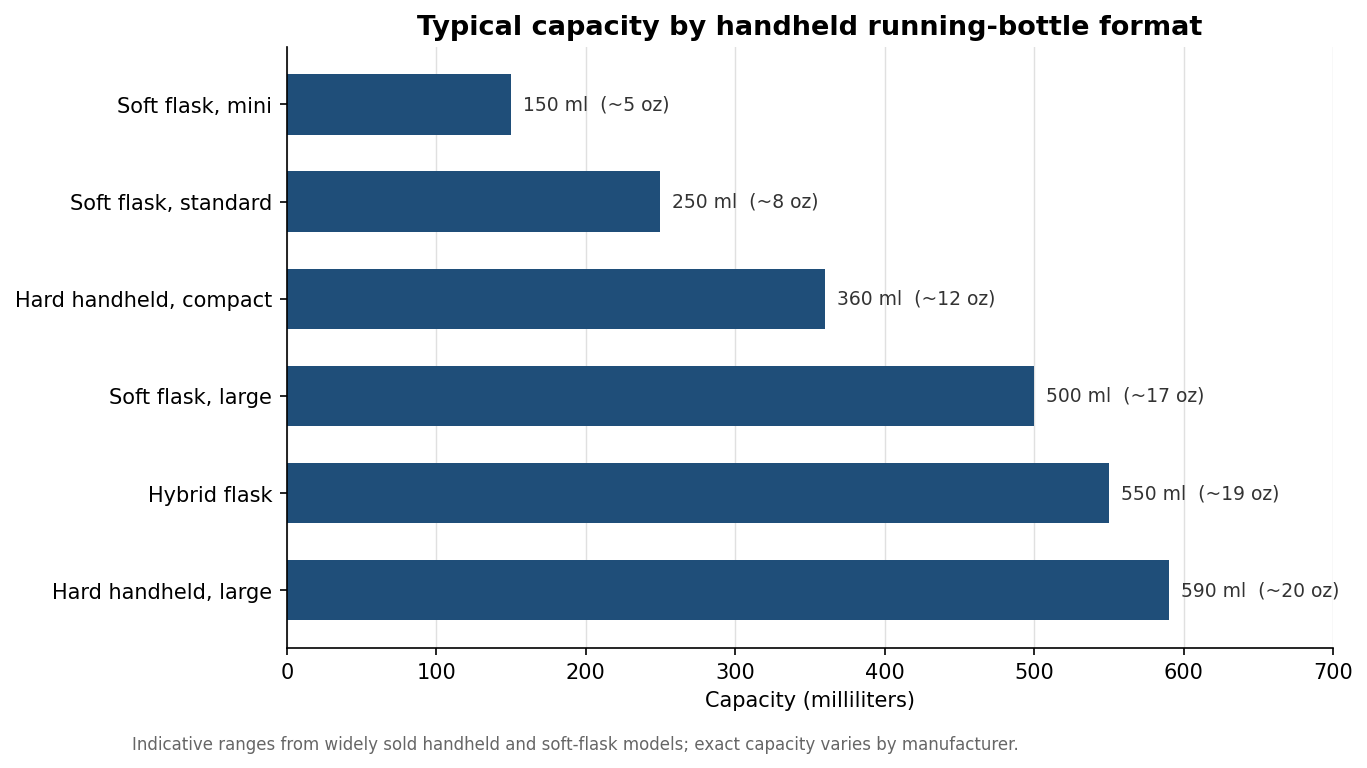
    Horizontal bar chart of typical handheld running-bottle capacities from 150 ml soft flask to 590 ml hard handheld
    Common handheld formats span roughly 150 ml to 590 ml (about 5 to 20 ounces).

    To turn that into a specification, work backward from the run the bottle is meant to support. A widely used rule of thumb puts fluid needs somewhere between 400 and 800 milliliters per hour, with the higher end reserved for heat and heavy sweaters. That maps cleanly onto run duration: a 30-minute effort rarely needs more than a compact flask, while anything approaching 90 minutes either demands a large bottle or a plan to refill.
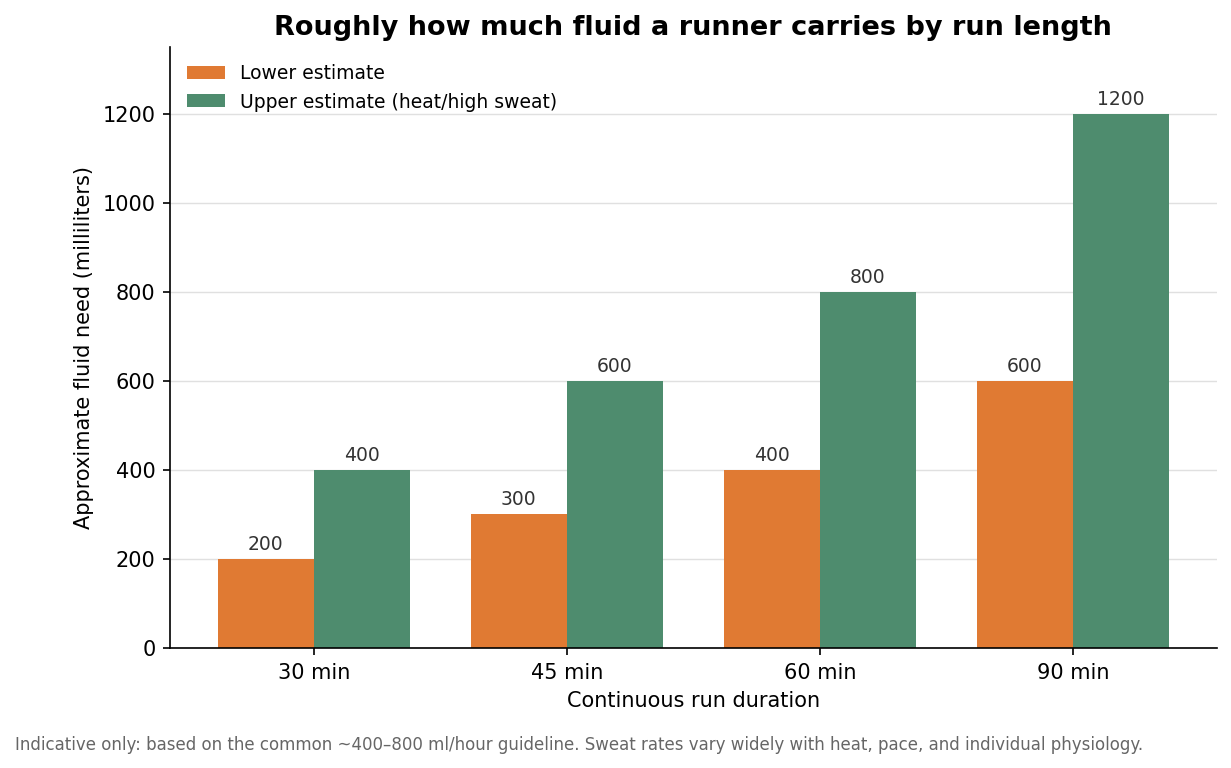
    Grouped bar chart of approximate fluid needs by run duration, lower and upper estimates from 30 to 90 minutes
    Approximate fluid to carry by run length, using the common 400 to 800 ml per hour guideline.

    These figures are indicative rather than exact. Individual sweat rates vary widely, and a cool morning 10K and a July long run are not the same problem. The useful takeaway for a bulk order is to match the dominant use case: a 5K race-day giveaway is well served by a 350-to-500-milliliter bottle, while an ultra crew or a run club logging long weekend miles will reach for the 500-to-590-milliliter end. When a single order has to cover a range of runners, the larger size is the safer default, because a runner can always carry a big bottle half full but cannot stretch a small one.

    The strap is half the product

    A handheld succeeds or fails on its strap, because the entire point is to carry water without gripping it. Look for an adjustable palm strap that tightens as the bottle empties, so the bottle stays snug against the hand rather than swinging loose. A thumb loop helps some runners and irritates others, so it is worth sampling before committing a large run. The strap material matters too: a breathable mesh or neoprene band is more comfortable over a sweaty hour than a stiff webbing strap.

    Most handhelds also carry a small pocket on the strap, and its size is a real specification, not an afterthought. A zippered pocket sized for a key and a gel is standard; a larger stretch pocket that swallows a modern phone is a distinct feature that adds bulk and cost. Decide up front whether your runners carry a phone in-hand, because retrofitting a bigger pocket is not something you do after the order ships.

    Design for the surface you are actually printing

    Branding a handheld is not the same job as branding a flat mug, and the format you chose in the first step decides what is possible. A hard bottle offers a firm, curved wall that takes a screen or pad print cleanly and holds a crisp logo. A soft flask flexes, so ink has to tolerate bending without cracking, and the usable print area is smaller and less flat. In practice, complex full-color artwork survives better on a hard bottle or on a fabric strap sleeve, while a soft flask is best given a simpler, high-contrast mark.

    Two details protect the finished look. First, keep the logo clear of the seam and the valve, where curvature distorts artwork and abrasion wears it fastest. Second, remember that the strap and pocket are prime branding real estate that many buyers ignore; a sublimated strap can carry a race name or sponsor logo without touching the bottle at all, which is especially useful when the flask surface is too flexible for detailed printing.

    Putting the specification together

    A complete handheld spec answers four questions in order: which format, what capacity, which strap and pocket, and where the branding goes. Get the format and capacity right and the bottle simply works on the run; get the strap right and runners actually reach for it again; get the print placement right and the branding still looks sharp after a season of sweat and refills. Decide those deliberately rather than defaulting to whatever sample landed on the desk, and a custom handheld stops being swag that ends up in a drawer and becomes gear that people keep using, logo and all.

  • A Race Director’s Guide to Running Bottle Margins — Custom Running Bottles

    Call or Text us: (929) 605-4397

    Home › Blog › A Race Director's Guide to Running Bottle Margins

    Ordering

    A Race Director's Guide to Running Bottle Margins

    06/30/2026

    Most race directors price a branded bottle as a straight cost against a registration budget line, see the number, and stop there. That comparison misses the two things a well-placed running bottle actually does: it becomes a sellable registration add-on, and it opens a sponsor line item that didn’t exist before.

    Here is a simple way to think about the economics before your next race.

    The real per-unit gap

    A blank handheld bottle costs only slightly less than a custom screen-printed one at volume; at 1,000 units, the branding premium often works out to less than the cost of a single race-day energy gel.

    Where the return shows up

    A branded bottle offered as a $5–$8 registration add-on typically covers its own cost and then some, while a sponsor-funded bottle line turns a cost center into a sponsorship package you can sell before the race even happens.

    Order sizeTypical per-unit range*
    100$7–$9
    500$5–$7
    2,000$4–$5
    10,000+$3–$4

    *Estimates only, illustrative of typical volume pricing — request a quote for your exact specs.

    Structuring a sponsor buy-in

    A simple rule of thumb: sell the bottle as its own sponsorship tier, priced to cover unit cost plus a margin, rather than bundling it invisibly into a general sponsorship package. Sponsors respond well to a tangible, keep-forever item they can point to.

    Key takeawayA custom running bottle typically adds only a small premium per unit at volume, and it opens a sellable line — registration add-on or sponsor tier — that a blank bottle never could.

    Ready to plan your race’s bottle program? Get a custom quote — free mockups in 24–48 hours. Learn more about how we work, or browse more guides.

    More posts

  • How to Order Custom Running Bottles for Your Next Race: A Checklist — Custom Running Bottles

    Call or Text us: (929) 605-4397

    Home › Blog › How to Order Custom Running Bottles for Your Next Race: A Checklist

    Ordering

    How to Order Custom Running Bottles for Your Next Race: A Checklist

    06/05/2026

    Ordering race swag on a tight timeline is stressful mostly because nobody tells you what order the decisions need to happen in. Here’s the checklist we walk race directors and program coordinators through so nothing gets missed between a quote and a shipped order.

    Work through it roughly in this order.

    1. Lock your quantity early

    Base your order on registered field size (or membership count) plus a 5–10% buffer. Ordering too tight means a reorder at a rush rate; ordering too loose just sits in storage.

    2. Send artwork as early as possible

    Vector files move fastest. If you only have a low-res logo, tell us up front — recreating it print-ready adds a day or two to the mockup, which matters if your in-hands date is firm.

    3. Pick format before color

    Format drives price and lead time more than color does. Decide handheld, stainless, soft flask, belt-clip, or kids bottle first, then choose from the color options available for that format.

    4. Confirm your in-hands date, not just your race date

    Build in a buffer between delivery and race day for check-in, sorting into swag bags, or distributing to a run club roster. Tell us the date you need bottles in hand, not the event date itself.

    StepTypical timing
    Submit quote request6–8 weeks before in-hands date
    Approve mockupWithin 2–3 days of receiving it
    Production2–3 weeks after approval
    Shipping buffer3–7 days
    Key takeawayLock quantity and artwork first — those two decisions determine almost everything else about your timeline.

    Ready to start your order? Get a custom quote — free mockups in 24–48 hours. Learn more about how we work, or browse more guides.

    More posts

  • Does a Custom Running Bottle Actually Hold Up? A Durability Comparison — Custom Running Bottles

    Call or Text us: (929) 605-4397

    Home › Blog › Does a Custom Running Bottle Actually Hold Up? A Durability Comparison

    Durability

    Does a Custom Running Bottle Actually Hold Up? A Durability Comparison

    05/10/2026

    A running bottle earns its branding budget by surviving contact with the world — dropped on pavement at an aid station, left in a hot car after a Saturday long run, stuffed wet into a gym bag. Not every format handles that abuse the same way.

    Here’s what actually happens to each of our formats under real training conditions.

    Impact resistance

    HDPE handheld and belt-clip bottles flex on impact rather than cracking, which makes them forgiving on pavement or trail rock. Stainless steel dents before it cracks, so a hard drop can leave a cosmetic mark but rarely a functional failure. Soft flasks simply can’t crack — there’s no rigid shell to fail.

    Heat and UV exposure

    All three materials tolerate a hot car reasonably well over a single afternoon, but repeated heat cycling over a season can make HDPE slightly more brittle at the seams and can fade unprotected screen print faster than a laser-engraved mark, which doesn’t fade at all.

    Decoration wear over a season

    Screen printing on HDPE holds up to months of normal handling, but repeated hard scrubbing or dishwasher cycles will eventually dull it. Laser engraving on stainless steel is functionally permanent — it’s cut into the surface, not printed on top of it, so there’s nothing left to wear off.

    FormatDrop resistanceDecoration longevity
    Handheld Strap BottleHigh (flexes)Good with hand-washing
    Stainless Steel BottleHigh (dents, doesn’t crack)Excellent (engraved)
    Collapsible Soft FlaskVery high (no rigid shell)Good, flex-rated ink
    Key takeawayEvery format we make is built to survive a full training season — the real choice is which failure mode you’d rather avoid: cracking, fading, or bulk.

    Ready to spec a bottle built for your training conditions? Get a custom quote — free mockups in 24–48 hours. Learn more about how we work, or browse more guides.

    More posts

  • Run Clubs, Charities, and Corporate Wellness: Who Orders Custom Running Bottles — Custom Running Bottles

    Call or Text us: (929) 605-4397

    Home › Blog › Run Clubs, Charities, and Corporate Wellness: Who Orders Custom Running Bottles

    Buyer guides

    Run Clubs, Charities, and Corporate Wellness: Who Orders Custom Running Bottles

    04/19/2026

    Not every buyer wants the same bottle for the same reason. A run club, a charity 5K, and a corporate wellness team all order custom running bottles — but they’re solving three different problems, and the format that works for one often misses the mark for another.

    Here’s how each buyer typically approaches the order.

    Run clubs & fitness studios: everyday carry over one-time handout

    Run clubs order in smaller batches — often 100 to 300 — as a welcome gift for new members or a milestone reward. They lean toward the stainless steel bottle because it’s meant to be used every week, not once at a single event.

    Charity & fundraising runs: visibility that outlasts the event

    Charity runs order in the hundreds to thousands, usually as a registration add-on or a thank-you gift bundled with a donation tier. The handheld strap bottle is popular here because it keeps the cause’s name in front of donors long after the event ends, at a price point that doesn’t eat into the funds raised.

    Corporate wellness programs: practical gifts tied to participation

    Corporate teams order for step challenges, 5K sign-up incentives, and wellness kickoffs, usually in batches sized to headcount. They favor the stainless steel or handheld bottle depending on whether the goal is a keep-forever gift or a lower-cost participation token.

    BuyerTypical order sizePreferred format
    Run clubs100–300Stainless Steel Running Bottle
    Charity runs500–5,000Handheld Strap Bottle
    Corporate wellness200–2,000Stainless or Handheld
    Key takeawayMatch the bottle to the relationship — a one-time handout calls for a different format than a gift meant to be used every week.

    Ready to find the right fit for your program? Get a custom quote — free mockups in 24–48 hours. Learn more about how we work, or browse more guides.

    More posts

  • HDPE vs. Stainless Steel: Choosing a Custom Running Bottle — Custom Running Bottles

    Call or Text us: (929) 605-4397

    Home › Blog › HDPE vs. Stainless Steel: Choosing a Custom Running Bottle

    Buyer guides

    HDPE vs. Stainless Steel: Choosing a Custom Running Bottle

    03/29/2026

    Most of our new customers arrive knowing they want a branded running bottle and unsure which material fits their event. The two core materials we work with — BPA-free HDPE and stainless steel — solve genuinely different problems, and picking the wrong one usually shows up as a complaint six months later, not on delivery day.

    Here’s how to think about the trade-off before you order.

    HDPE: lightest, cheapest, built for the run itself

    HDPE is the material behind our handheld strap, belt-clip, and kids formats. It’s light enough to forget you’re carrying it, cheap enough to hand out by the thousand at a race, and tough enough to survive a drop on pavement without cracking.

    Stainless steel: insulated, permanent, built to keep

    Stainless steel adds double-wall vacuum insulation and a heavier, premium feel — it keeps water cold for hours and reads as a gift rather than a giveaway. It costs more per unit and isn’t meant for a mid-race handheld grip, but it’s the format people keep using at their desk a year later.

    Decoration holds up differently on each

    Screen printing on HDPE is fast, affordable, and holds up well to a season of use. Laser engraving on stainless steel is slower and pricier per unit, but the mark is permanent — it won’t fade, chip, or wash off no matter how many times the bottle gets refilled.

    HDPEStainless steel
    Weight (empty)Under 3 oz6–9 oz
    InsulationNoneHours of cold retention
    Relative costLowerHigher
    Best forRace handouts, kids’ eventsGifts, wellness programs
    Key takeawayChoose HDPE for a race-day handout runners use once and keep; choose stainless steel for a gift you want them reaching for all year.

    Ready to choose a material? Get a custom quote — free mockups in 24–48 hours. Learn more about how we work, or browse more guides.

    More posts

  • Custom Running Bottles for Marathons and Race-Day Swag — Custom Running Bottles

    Call or Text us: (929) 605-4397

    Home › Blog › Custom Running Bottles for Marathons and Race-Day Swag

    Marathons

    Custom Running Bottles for Marathons and Race-Day Swag

    03/15/2026

    A marathon’s swag bag is one of the only pieces of the race a runner keeps in their hands for months after the finish line. Bibs get folded into a drawer, medals hang on a hook, but a bottle gets refilled every day — which makes it one of the highest-return branding placements a race organizer can buy.

    Here is how the best-run race series actually use custom running bottles across the event lifecycle.

    Packet pickup vs. finish-line handout

    Bottles handed out at packet pickup get used during the race itself — a smart placement for a handheld strap bottle that a runner clips on before the start. Finish-line handouts work better for a heavier, keep-forever format like a stainless steel bottle, since runners are drained and grateful rather than mid-race and rushed.

    Sponsor visibility that lasts past race day

    A single race-day banner comes down within hours; a printed bottle rides in a runner’s car, gym bag, and desk for a full training cycle. That’s why title sponsors increasingly ask for logo placement on the bottle itself rather than (or in addition to) the bib or the finisher shirt.

    TouchpointBest-fit format
    Packet pickupHandheld Strap Bottle
    Aid stations / relayBelt-Clip Hydration Bottle
    Finish-line handoutStainless Steel Running Bottle
    Kids’ fun runKids Running Bottle

    *General guidance — request a quote to match a format to your specific race format and budget.

    Planning quantities against registration

    Most race directors order close to their registered field size plus a 5–10% buffer for late registrations, volunteers, and sponsor allotments, rather than trying to guess demand after the fact.

    Key takeawayA branded running bottle keeps working as a sponsor impression for months after race day, long after banners and bibs are gone.

    Ready to upgrade your race-day swag? Get a custom quote — free mockups in 24–48 hours. Learn more about how we work, or browse more guides.

    More posts