Most guides to running bottles start with color and logo placement. The decision that actually shapes how a bottle performs on the road happens earlier, when you choose the format and the capacity. A handheld running water bottle lives in one hand for the length of a run, so a 100-milliliter mismatch or a strap that does not cinch down becomes a genuine annoyance by mile three. This walkthrough covers how to specify a handheld the way an experienced buyer would: format first, then capacity, then the strap, and only then the print.
Soft flask or hard bottle: settle the format first
Handhelds split into two families, and they behave differently enough that the choice drives everything downstream. A hard bottle holds its shape, refills quickly at an aid station or fountain, and can carry an insulating sleeve to keep water cool. It sloshes as it empties and it still takes up hand space when drained. A soft flask, molded from flexible TPU, collapses as you drink, which kills the sloshing and lets the empty flask fold into a pocket. The trade is that soft flasks are fiddlier to refill on the move and harder to fill with ice or drink powder through a narrow opening.
There is also a middle option worth knowing about. Hybrid flasks sit between the two: softer than a rigid bottle but more structured than a thin soft flask, usually with a wider valve that pours faster. For a race brand deciding what to hand out, the practical read is simple. Choose a hard handheld when refills are frequent and durability matters, choose a soft flask when weight and pack-down size win, and consider a hybrid when you want one product that does a bit of both.
Size the bottle to the run, not to the shelf
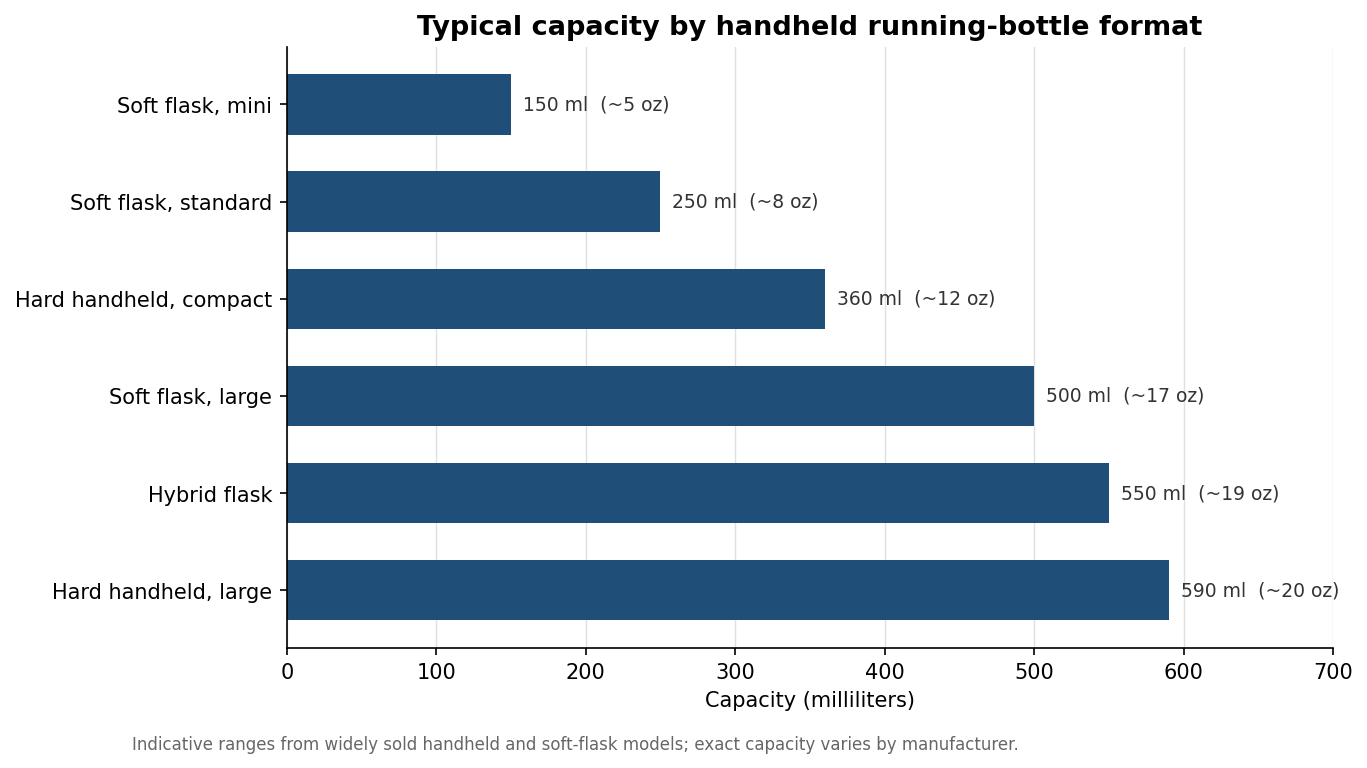
Capacity is where buyers most often over- or under-shoot. The common formats cluster into a predictable ladder, from mini soft flasks around 150 milliliters up to large hard handhelds near 590 milliliters, which is roughly 20 ounces. Seeing them side by side makes the gaps obvious.
To turn that into a specification, work backward from the run the bottle is meant to support. A widely used rule of thumb puts fluid needs somewhere between 400 and 800 milliliters per hour, with the higher end reserved for heat and heavy sweaters. That maps cleanly onto run duration: a 30-minute effort rarely needs more than a compact flask, while anything approaching 90 minutes either demands a large bottle or a plan to refill.
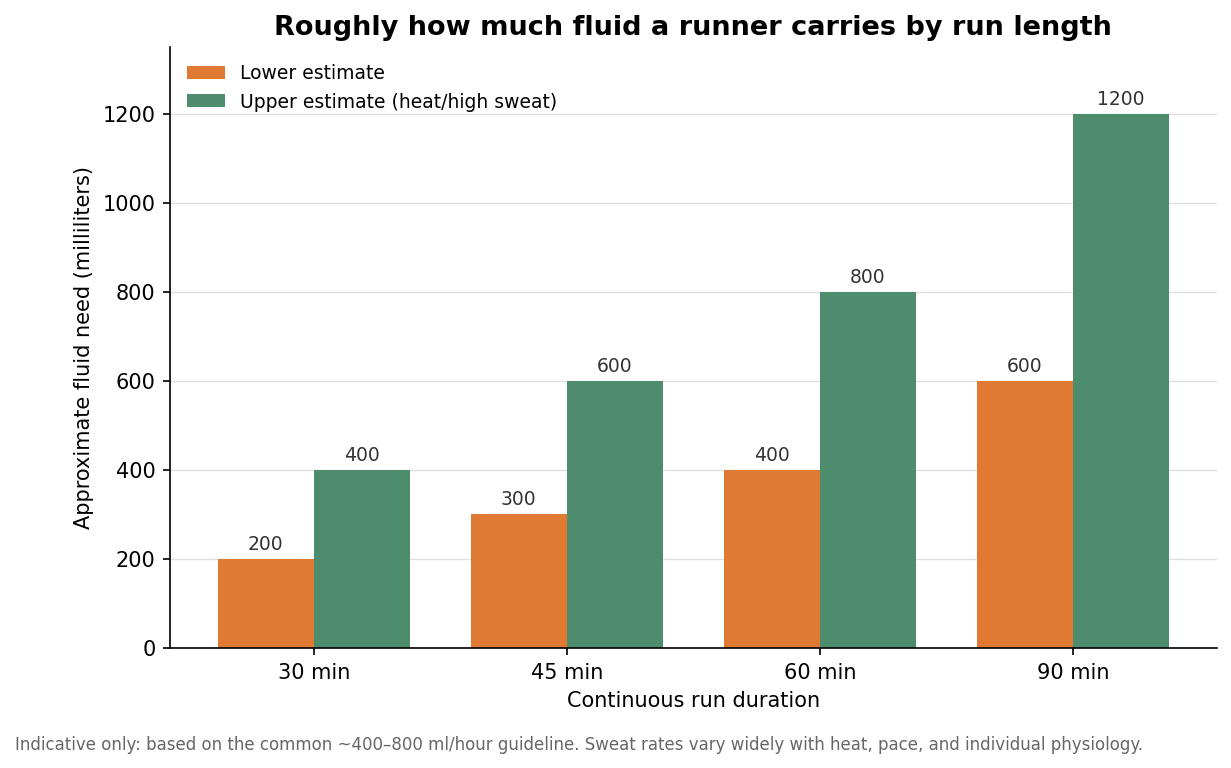
These figures are indicative rather than exact. Individual sweat rates vary widely, and a cool morning 10K and a July long run are not the same problem. The useful takeaway for a bulk order is to match the dominant use case: a 5K race-day giveaway is well served by a 350-to-500-milliliter bottle, while an ultra crew or a run club logging long weekend miles will reach for the 500-to-590-milliliter end. When a single order has to cover a range of runners, the larger size is the safer default, because a runner can always carry a big bottle half full but cannot stretch a small one.
The strap is half the product
A handheld succeeds or fails on its strap, because the entire point is to carry water without gripping it. Look for an adjustable palm strap that tightens as the bottle empties, so the bottle stays snug against the hand rather than swinging loose. A thumb loop helps some runners and irritates others, so it is worth sampling before committing a large run. The strap material matters too: a breathable mesh or neoprene band is more comfortable over a sweaty hour than a stiff webbing strap.
Most handhelds also carry a small pocket on the strap, and its size is a real specification, not an afterthought. A zippered pocket sized for a key and a gel is standard; a larger stretch pocket that swallows a modern phone is a distinct feature that adds bulk and cost. Decide up front whether your runners carry a phone in-hand, because retrofitting a bigger pocket is not something you do after the order ships.
Design for the surface you are actually printing
Branding a handheld is not the same job as branding a flat mug, and the format you chose in the first step decides what is possible. A hard bottle offers a firm, curved wall that takes a screen or pad print cleanly and holds a crisp logo. A soft flask flexes, so ink has to tolerate bending without cracking, and the usable print area is smaller and less flat. In practice, complex full-color artwork survives better on a hard bottle or on a fabric strap sleeve, while a soft flask is best given a simpler, high-contrast mark.
Two details protect the finished look. First, keep the logo clear of the seam and the valve, where curvature distorts artwork and abrasion wears it fastest. Second, remember that the strap and pocket are prime branding real estate that many buyers ignore; a sublimated strap can carry a race name or sponsor logo without touching the bottle at all, which is especially useful when the flask surface is too flexible for detailed printing.
Putting the specification together
A complete handheld spec answers four questions in order: which format, what capacity, which strap and pocket, and where the branding goes. Get the format and capacity right and the bottle simply works on the run; get the strap right and runners actually reach for it again; get the print placement right and the branding still looks sharp after a season of sweat and refills. Decide those deliberately rather than defaulting to whatever sample landed on the desk, and a custom handheld stops being swag that ends up in a drawer and becomes gear that people keep using, logo and all.
Leave a Reply